
The Vision
When thinking about and planning for Not Safe For Treatment, our main aim was to create a space whereby those who had been mistreated, silenced or denied the opportunity to right the wrongs of their mental health care could feel safe enough to express their experience in the way they felt most comfortable to. We wanted to bring artists together and create a community of people who have a shared understanding of what it is like to enter into mental health services and find they now have more to process than before they were part of such a confusing system.
Overall, we wanted to create a safe, supportive and understanding environment of art that tells uncensored stories.
Nine artists, two curators, one luckily free venue, zero funding and a hope that we could create something.
An exhibition exploring personal navigations of modern mental health systems.
With similar experiences and the same frustrations, we hoped to create feelings of safety and community through art.
The Curators
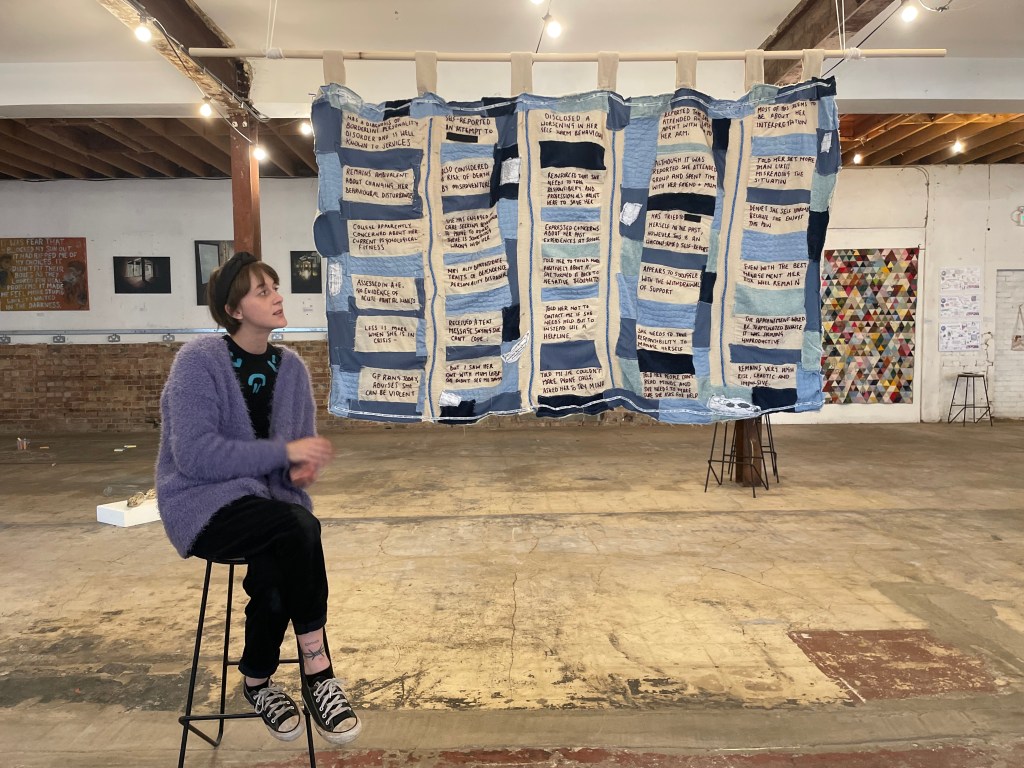
Leah May
Leah is not formally educated in art or writing but found creativity when she was small and experiencing something that she didn’t realise would shape how she eventually navigated life. She remembers making paper mache masks and writing stories as a form of escapism. As she grew up, she found she would always return to creative expression, gravitating towards things that she could get hands-on with. When she became housebound towards the end of 2014, she filled her days by painting delicate watercolours of the outside that she was too fearful to be a part of and focussed her energy on writing blog posts as a way to find connection when she couldn’t get out to meet people.
When she eventually found herself forced to seek help for her mental health, she found that the system she had now been thrown into was one that she couldn’t understand. Something that was consistently thrown at her though, was art and creativity as a way of distracting herself. As a result of dutifully following these tips and directions, art and creativity no longer felt comforting or a way to stay present, instead, it was just another instruction that she had to follow instead of processing what she needed to. The system didn’t want a fix, it wanted an avoidance and this led her to falling out of love with being creative.
As the years went on and things didn’t get much easier, Leah realised when looking back that creative expression was one of the most useful tools she had in her kit- not because it distracted her or kept her well, but because it gave her the ability to get exactly what she needed at that moment without the risk of more hurt. Rediscovering creativity has been a blessing for her and coming to the realisation that the art she has created has been a combination of unconditional acceptance, active listening, freedom to express, a way of re-finding a voice and has also served as both a teacher and a friend has been invaluable.
Leah uses her art to test her own boundaries in a safe way and tell her story when the words won’t come out. It has given her time to process and allowed her to express emotions that don’t usually feel safe enough. It has helped her to feel empowered to own her experiences, especially the ones that in the past have been censored, silenced and denied.
Her art is far from perfect. She doesn’t colour within the lines, stitch straight or create masterpieces but the things that she does make almost always support her to navigate painful experiences that she hasn’t been able to figure out elsewhere. She finds catharsis in using the chaos of the bigger part of her life and the narratives that have been woven around her as a result to make pieces that allow her to feel more in control of her story. Slowly she has begun unravelling the sticking points in her experiences and is finding her voice. Her aim in all of her pieces is to reclaim expression, without censorship or the risk of being wrong and she hopes that interacting with her work can allow others to think about the processes that those with mental illness must navigate before they can even consider getting well.
Leah is passionate about social justice and the hidden complexities of the UK mental health system that still persist. Her biggest hope from sharing her pieces is that people will join in with starting conversations around the topics that are often shied away from and that more will be motivated to get involved in using their voice for change, whatever that looks like for them.
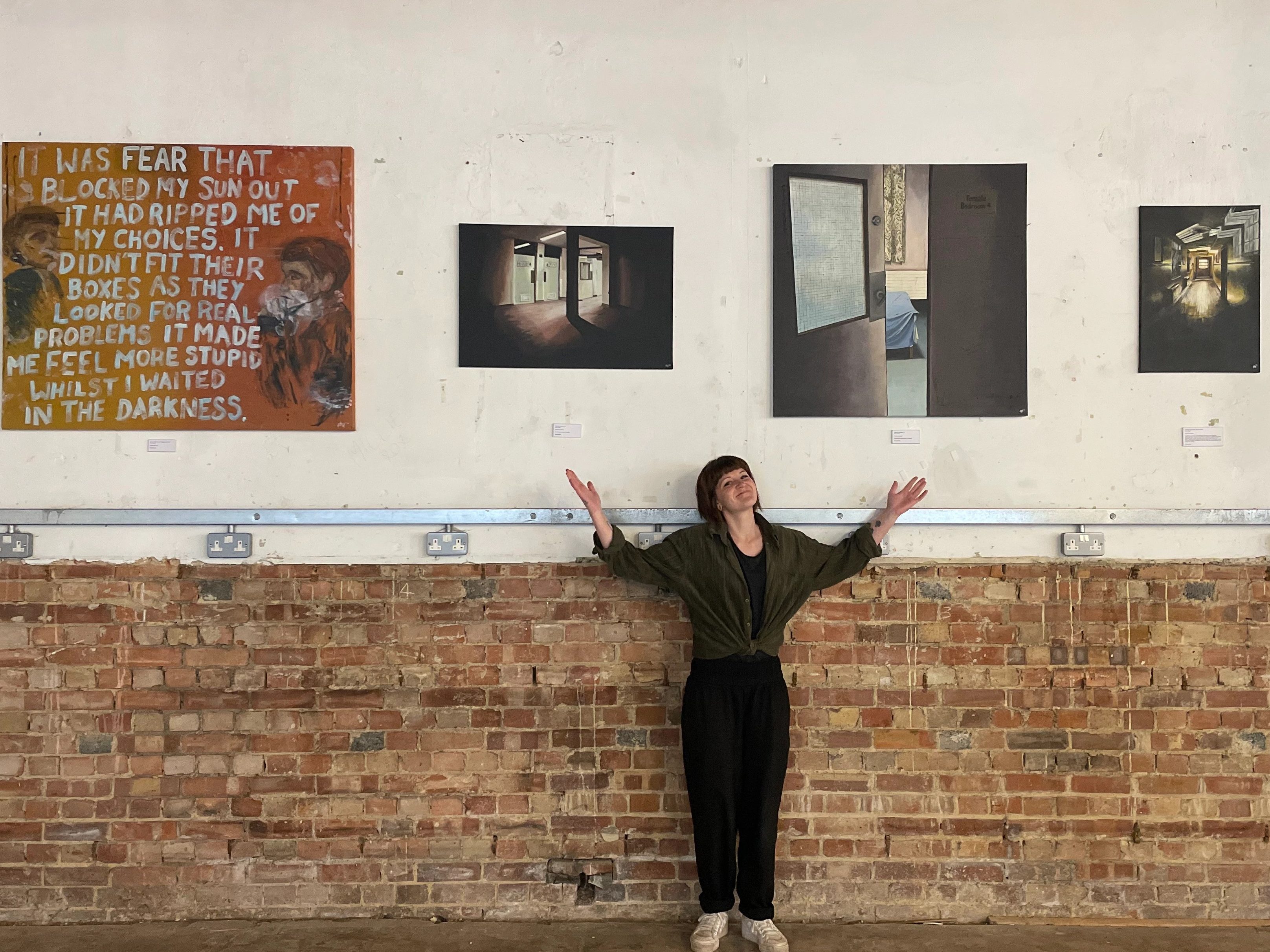
Fenn Harris
Fenn completed her HND in Fine Art at Greenwich University in 2009 and then moved to Norwich in 2014 in the hope of going to the Norwich University of the Arts. She got in and completed her first year in Illustration but became too unwell to continue the second year which she attempted twice. Her work has been a constant throughout her life and even with large gaps in practice, it’s always something that finds her again. More recently, she has found more importance in sharing ideas with others and bouncing influences between other creatives. She hopes this exhibition will be the first of many more, to give more people the chance to feel proud and safe to tell their stories and feel the benefit of the creative process when dealing with such difficult topics whether as the artist or as the beholder.
She has worked with sculpture, collage and print previously but more recently has moved into painting and mixed media, enjoying the tactile layering of textures. It has been a new venture for her to use textiles for this exhibition. The repetitive process was so beneficial and cathartic that she is considering continuing to use them in the future. Her latest treatment in London was extremely supportive of her art practice and worked on paralysing perfectionism and ‘what ifs’. They encouraged her to fill the corridors with murals and coached her to do her first canvas in a long time with a deadline, which led to the collection of paintings shown in this exhibition.
Fenn has faced a lot of bad practices and chasing up policies during her time in services, still without resolve and has a lot of feelings of frustration and injustice. She had been trained to be good, quiet and not difficult. As the conditions of her care became worse and she began to advocate and know the system and understand the medical language, she increasingly became concerned about others within this service who may not have the voice or awareness to advocate. Her initial years of treatment only offered avoidance and distraction techniques, which her obsessive and compulsive mind thrived upon and ultimately put her into the very physically and mentally terrifying place of entrapment which she almost didn’t return from.
She considers herself lucky to have supportive friends and family who found her the treatment she needed which she fought incredibly hard for at her worst. This is sadly not the case for everyone. She wants to keep fighting for safety, proper practice and resolution, especially for those without a voice, as well as help others creatively to work through the frustrations that come with no accountability, no resolve, answers or closure.
Fenn is now focussing on spaces, what they feel like and what impact they have, especially in therapeutic or inpatient settings. She has been recently working with the new local hospital initiative whilst exploring these ideas through creative research practices. She wants to explore the attitudes around risk and compassion in these spaces and what more can be done to make those stays safer, more comfortable and more effective.
 NotSafeForTreatment